

 |
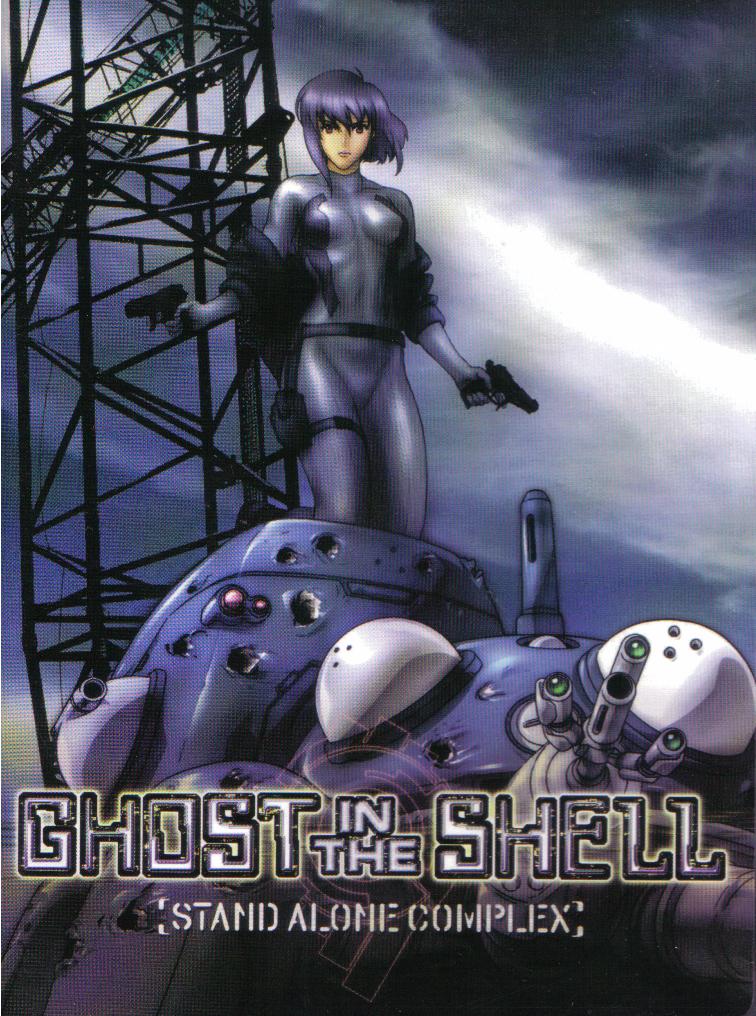
Aeria Gloris Ghost in the Shell universe has its roots in a manga by Mamoru Oshii. The first movie to be made based on that manga was remarkable for its cutting edge animation and its novel simultaneous release in Japan and the U.S. The second movie continued the story of the first and took the cyber punk and existential qualities that hallmark this universe to a new height. The manga and the movies apparently built quite a fan base, because out of Production I.G comes a lavishly animated 26 episode series based on the material. To be clear, this series is not in the same continuity as the movies or the manga. However, it does retain the same cast of characters and general themes. The story takes place in the near future, when advances in cybernetics have begun to blur the line between man and machine. The main character is a female cyborg named Motoko Kusanagi who is a Major in a secretive Japanese police agency known as Section 9. Major Kusanagi and the other members of Section 9 are Japan's first line of defense against hackers, terrorists, and corrupt politicians. I have never read the manga, so when I watched the movies I was a little unclear about the origins of the Ghost in the Shell universe and the relations between the characters. Given the ambitious objectives both of the movies had for storytelling, there wasn't a whole lot of room left for exposition and I felt that the movies could be well-nigh impenetrable at times. However, in the expanded format of 26 episodes, there is now a lot more room for characters to grow. At the end of the series, I felt a new attachment to the characters that I just couldn't develop from watching the movies. Also, the episodic nature of the series means until the slam-bang conclusion the plots are generally simpler and easier to follow than the confusing and philosophy-laden movies. That doesn't mean that the plot of Standalone Complex gets bogged down in "filler" episodes, however. At its core, Standalone Complex is a police story, and I actually found several of the episodes reminiscent of Patlabor (not a bad thing in my opinion!). The overall arc deals with a super hacker named The Laughing Man who is introduced early and then gradually becomes an increasingly important character. The Standalone Complex takes place in a futuristic Tokyo, a setting which has been done so often in Anime that it has become a bit clichéd. However, the series manages to make things interesting by dropping little hints here and there about the history spanning the time of the series and our own. Issues like the beginning of cyberization of people and global upheaval are just a couple. As an officer in the US Navy, I found references to the American Empire and the American Imperial Navy to be especially amusing. This world is brought to life by a very slick combination of CG and hand-drawn animation that is simply beautiful to behold. Quite honestly, this series is one of the best looking I've seen. The Standalone Complex sounds just as good as it looks, too. The music is more conventional than the tracks used in the movies, and while they are easier on the ears they are also more generic. The opening theme is a winner, though; I still can't figure out what language it is being sung in! Both the Japanese and English voice acting is superb. Many of the voice actors from the movies reprise their role in the series, which makes the transition easier. Honestly, this is one of the rare series where the dub is every bit as good as the original Japanese voice track. The DVD release is a bit odd in that it divides the 26 episodes across 7 discs. Normally, this is done either on 6 or 8 discs. This anomaly aside, the DVDs themselves are very nicely done. The menus are done in the same stile as the user interfaces seen in the show, and the artwork on the jacket is nicely stylized and rendered. The extras mainly consist of interviews with the production staff, which is the type of feature I always find most fascinating. I should also note that Manga has released Special Edition discs to go along with the regular releases that contain soundtracks and special art boxes for an additional cost. I stuck with the normal (read: less expensive) release, however. Bottom line, this series is a joy to watch. If you thought the movies were intriguing but had a little bit of trouble wrapping your head around all the complex themes they threw at you (like me), then the Standalone Complex is just your thing. It tones down all of the philosophical meandering and mixes in a well balanced mix of action, mystery, and science fiction. Newcomers to the Ghost in the Shell franchise would also do well to pick up the series first. I can see a little bit of trouble coming for those fans who have read the Manga, watched both the movies, and generally dissected the Ghost in the Shell universe in that they may find this series to be a bit too basic. I, for one, enjoyed it immensely. By Andy Rucker |
||||||||||