

 |
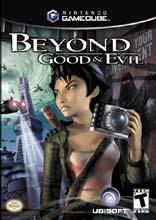
Real Journalism, Fair and Balanced Beyond Good & Evil is one of the games that slipped through the cracks on me over Christmas. I don’t recall hearing much about it before or at its release, but afterwards I started to hear more and more about how good this game was from people that had played it. Consequently, when I found out that the price of the game (at least the GameCube version) got slashed to $20 I decided to go ahead and take the plunge and order a copy. After about 10 hours, I have completed the main quest of the game, and I can safely say that $20 was well spent. Beyond Good & Evil is a mystery story that takes place in a sci-fi setting. The main character, a young woman named Jade, lives on a colony world known as Hylis. Hylis has become a battleground between humanity and a race of insectoid creatures called the DomZ. Jade is a budding photo journalist and becomes involved in the conflict when it becomes clear that the Alpha Sections (elite military units in charge of the defense of Hylis) are actually working in league with the DomZ to enslave the population of the planet. This story doesn’t break a whole lot of new ground as far as plot developments are concerned. I found that I could anticipate most of the major twists in the story, thanks to the fact that the writers appear to have relied on several tried and true sci-fi clichés. Nevertheless, the manner in which Beyond Good & Evil combines these elements is fresh enough to keep me interested. Actually playing this game is a very Zelda-esque experience. The view is third person, and your character has a number of upgradeable abilities that allow you to reach different areas as the game progresses. However, this game isn’t a slavish copy of the gameplay that was pioneered in Ocarina of Time and reined in Wind Waker. There is a sufficient number differences between the two games to separate Beyond Good & Evil from the Zelda series, and these features are lumped together into what the developer refers to as the Jade engine (I’m not sure if the game engine is named after the main character or vice versa!). Basically put, the Jade engine allows for a smoother style of gameplay, one that automatically and seamlessly switches modes between combat, exploration, and stealth. What this basically meant for me was that I spent far less time navigating inventory menu screens than I did with any Zelda game. Also, z-targeting or a variation there of has disappeared, as well as the ability to conduct weapons attacks when no enemies are around. I am still undecided as to whether or not all of these features are an improvement or not. On the one hand, they do make Beyond Good & Evil a very simple game to get into and a very smooth one to play. On the other hand, these features reduce the complexity of the game to the point where I feel it might be almost too easy. Besides the Jade engine, the other gameplay hook of Beyond Good & Evil is that photography plays a major role in the game. As a photo-journalist, Jade and her skills with a camera become the key to revealing the DomZ plot. Fortunately, Beyond Good & Evil looks sufficiently good enough to make you want to take pictures of it. The environments and dungeons are really well done, both in terms of their polygon construction and their texturing. The character and animal designs are also pretty good, but their design is a little, shall we say…off color. I have to be honest here; I think that the Alpha Section soldiers all look like rejected designs from a “Design an Evil Buzz Lightyear” competition. Little chicken legs, a big barrel shaped torso, and a goofy helmet make the look complete. Also, apparently Hylis is home to a number of anthropomorphized species, as there are pig-people, cat-people, shark-people, and even cow-people. Yikes! Anyway, at the very least these little quirks in the game’s graphics design really do lend a distinct feel to it. Aesthetically, though, I just did not take to certain elements of it. The very competent graphics and gameplay of this game is backed up by some even better sound direction. The music in the game is fairly unobtrusive for the most part, but there are some memorable pop songs that get played during some of the mini-games and in certain locations. There is also a fair amount of spoken dialogue in the game, which really helped me to get into the story a bit more. However, a significant portion of the dialogue is still text only, and I found it a little disconcerting to switch between listening to spoken dialogue and reading text. Overall, Beyond Good & Evil is a game that benefits from quality production values coupled with an intriguing concept and a novel execution. The Jade engine really does make the game flow much more naturally, although I am concerned that it may make the game to easy and simplistic. However, other touches (such as the spiral menu design) contribute to an overall sense of freshness about this game that I found really enjoyable. Really, the only serious knock I can make against this game that it ends too quickly. As I said, I blew through the main plotline in just under 10 hours, which is pretty short for an adventure game. It really left me unsatisfied in this respect; It is as if Ocarina of Time ended right after you received the Ocarina and traveled to the future! Even so, you could do a lot worse than Beyond Good & Evil for your gaming dollar. This game delivers a quirky adventure game with a lot of character and a number of fresh ideas, and is harmed only by its modest length. By Andy Rucker |
|||||||||||||||||