

 |
|
Donky Konga 1 & 2 Import Impressions
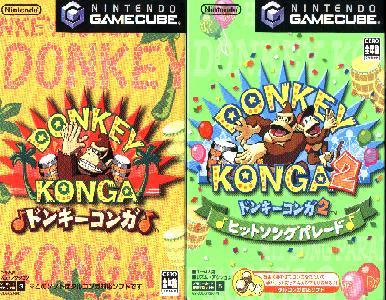
It's Konga Time! I am compelled to preface these remarks with a disclaimer: I am not much of a music game fan. Oh, I have certainly had my flirtations with this genre, whether it be a few rounds of Dance Dance Revoulution at an arcade or a bout or two of Samba de Amigo at a friends house. However, Donky Konga is the first music game I have ever actually owned, and I am loving every minute of it. The centerpiece of the Donky Konga experience is undoubtedly the bongo controller that comes packaged with the game. This controller is solidly constructed to resemble two stave barrel drums connected together. The controller is very simple, only being able to detect taps on either drum and claps. A start button is thrown in as well, to aid in making menu selections. The clapping feature is a little touchy, since the sensor looks for loud noises, and can thus be activated by loud noises or shouts as well as intentional claps. Tapping on the side of either drum will also register a clap, but this feature is sensitive, too. My friends and I discovered that the most effective way of holding the drums is to either sit in a chair with them locked between one's knees, or cross-legged on the ground with the controller in front of you. In either case, simply shifting the controller can often cause the game to register a clap. Fortunately, this over-sensitivity doesn't really affect gameplay much. I imported both the original Donky Konga game and the recently released Donky Konga 2: Hit Parade. Both games play essentially the same. In both cases, as a song plays there is a scrolling set of symbols that require one of four basic inputs: right drum, left drum, both drums, or a clap. There are also "rolls" for all of these, where the player must complete as many of these inputs as possible during a short period of time. The game has several difficulty levels, with the harder levels having more symbols and more difficult patterns to master. There are several different play modes available, including solo, a player vs. player head-to-head battle, and a four person mode that has each person playing a different part on screen. My friends and I fiddled with these a bit, and concluded that the head-to-bead battle mode was the most exciting. Unfortunately, since I only have one drum controller, one player had to use a control pad. In this mode, the left analog stick acts as one drum, the A button as the other drum, and the shoulder buttons as the clap input. Personally, I found Hori's Digital Controller to be easier to use than the standard GameCube pad, since the large D-pad made inputs more definitively. Even so, playing this game with a control pad, especially on the harder difficulty modes, struck me as awkward. Drums are definitely the way to go. Doing well in these game modes allows for mini games to be unlocked, but I don't have much to say about those. Just about every time I sit down to play this game, my attention is captivated by the main game (which isn't a bad thing, by any means!). The couple of mini games I briefly tried naturally play best with the drum controller. One in particular had a strings of four input symbols appear, and the players competed to input the symbols in the shortest amount of time. While gameplay is consistent between Donky Konga 1 and 2, the presentation is quite different. For example, Donky Konga 1 relies on static backgrounds and cheesily animated characters to dress up the screen during the game. The sequel instead uses fly-throughs of one of several polygonal environments, including a ski lodge and a carnival. These environments don't seem to have much to do with the song that is being played and appear to be chosen at random, but I think they are an improvement over the animation of the first game. Donky Konga 2 also does a better job at presenting the songs in an organized manner. The song titles appear in a color-coded box that identifies what genre (J-Pop, Anime, etc) the song is from. Song selection between the two is pretty good. In all conscience, I can not pick which game has the better music, as both discs have songs I like. I will say that I am glad I picked up both games, giving me 60-some songs to choose from. With only one disc and 30 songs, the game would probably be more repetitive. On the other hand, I haven't been playing a lot of the songs on either disc, so it could be more of an issue of the particular songs and not their quantity that makes the difference. The song selection is varied enough to be interesting, the controller is comfortable to use, and the game design is intuitive. However, this isn't a game that I picture myself playing in marathon sessions. I find that after an hour or so it becomes harder for me to concentrate on the symbols, and I have to take a break. Since this game almost demands to be played sitting down, it isn't as physically taxing as Dance Dance Revolution or even Samba de Amigo is. However, it is still quite mentally challenging for people like me who have exceedingly poor coordination. Partly to show off and partly to get a second opinion, I took this game over to a friend's house and had him and his brothers play it for an afternoon. They are much more accomplished music gamers than I, having both a DDR softpad and a well-used set of Samba maracas. The conclusion they reached is that Donky Konga is more fun than DDR, but doesn't have the same entertainment power that Samba has. They liked the drum controllers as much as I do, but they pointed out that they aren't as fun since they don't really produce much noise on their own. When a drum is struck, it makes a soft clicking nose, while a drum beat sound effect is then played by the game. These sounds can be changed to different "schemes" (think Windows), such as Annoying, Blood-Curdling, and Awful. Seriously, for the love of Geraniums and General Grant, stick to the default drum sounds. Either way, my friend's younger brothers argued that this isn't nearly as fun as the built-in rattle of a set of Samba maracas. Overall, I have found this game to be a lot of fun. Donky Konga does have some issues, but I am eagerly awaiting the US release so that I can get my hands on some more songs and another set of drums. This game has successfully entertained music game newbies (that's me) and veterans (my friend and his younger brothers) alike. I have also noticed that the simplicity of the drums and the intuitive gameplay draw the attention of non-gamers as well. Thus, I have no trouble recommending this game to just about anyone. by Andy Rucker
|