

 |
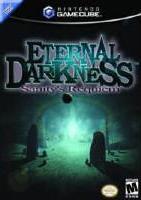
Three times into that Darkness Peering... Eternal Darkness is one of several mature games that were originally slated for a release on the N64 but instead were moved to the GameCube (other notable examples include Resident Evil 0). Developed by Silicon Knights, which is now a Nintendo second party, Eternal Darkness (ED) is a polished, enjoyable, and VERY disturbing (in a good way) game. Due to the fact that ED is a horror game, comparisons to the best-known series in the genre, Resident Evil, are inevitable. However, these two games couldn't be more different. First of all, ED is rendered entirely in real time, which allows for easier control and less disorientation (at the expense of losing some graphical quality). Secondly, the game play of ED is centered heavily on combat using a variety of swords, knives, and axes, while Resident Evil often forces the player to avoid confrontation due to a lack of health or ammo. Finally, and perhaps most fundamentally, Resident Evil games are about man's own science gone awry, where as ED deals directly with supernatural forces. The bottom line? ED is NOT a Resident Evil clone, so don't even go there. The plot of ED revolves around a young woman named Alex Roivas who is investigating the murder of her grandfather. During the process of this investigation, she discovers a strange book known as the Tome of Eternal Darkness. The levels in the rest of the game are constructed as if Alex was reading a chapter in the book. There are short segments between each chapter where you play as Alex, usually as she is trying to find the next chapter page that has been hidden somewhere in the Roivas family mansion. Each chapter takes place in an entirely different location with an entirely different person, but they all wind up working to stop the coming of the Ancients, who are god-like entities bent on the destruction of our world. Controlling your character in ED is much easier than in RE-style games, because of the use of a third person scheme. That is to say, when you press up, your character moves towards the top of the screen. Also, different characters control in slightly different ways. Some characters can run faster before they begin to get tired, for example. The game play of ED features a number of fresh features, not the least of which is the sanity meter. This meter is decreased whenever you are attacked by an enemy, and it is replenished slightly when you kill that enemy. If your meter gets low, strange events known as insanity effects begin to happen. Suffice to say some of them gave me a proverbial heart attack. INVISIBLE TEXT SPOILER: The effect I am referring to is the one where your menu screen suddenly pops up and a message appears that says "Now deleting all save information." The game then proceeds to allow you to scroll through the save blocks and look for your save files, to no avail. After a few seconds of this, the screen flashes back, and your character shouts "THIS ISN'T REALLY HAPPENING!" Insanity effects aside, this game features a rune-based magic system. The player must search each level to find a number of runes that allow him or her to cast certain spells. Spells allow you to enchant items, recover health or sanity, or even summon monsters. The game is split into chapters that each take place at different times several key locations, including a desert city, a house in Rhode Island, and a cathedral in France. Each chapter focuses on a different main character. The common thread for each of these chapters is the Tome of Eternal Darkness. During the first chapter, the player selects one of three possible orientations (red, blue, or green), and this affects the kinds of enemies seen throughout the entire game. This also means that in order to get the game's complete story, all three paths must be beaten. This will easily require about 20 hours (or more, if you are me!). As I mentioned before, combat is the core of ED's game play. The player is actually encouraged to kill every single nasty thing that he meets. This can be accomplished using blade weapons, guns, or magic spells. The player has the option of selecting certain parts of an enemy's body to attack, which can be very important to avoiding unnecessary health loss. For example, lopping off the head of a certain type of enemy will prevent it from exploding and doing splash damage. Graphically, ED has come a long way since its original N64 version. The textures are not super-detailed, but they are crisp enough to really draw the player into the game. Character designs are outstandingly detailed and accurate, and range from a Roman Centurion to a World War I infantryman. There are 4 basic classes of enemies, with several versions of each for the different color orientations. This means that while there is some variety, by the end of the game I was getting tired of facing zombie after zombie. On the plus side, the periodic boss encounters are some of the best I have seen outside of a Zelda title. The creatures faced in these battles are some of the most bizarre creations I have run across in a game. There are relatively few levels in the game and multiple chapters reuse certain locales. However, since each chapter takes place at a different point in time, the levels are never the same twice. Certain areas will be changed, new areas will be added, and other areas will be closed off. The result is that each location within the game is familiar, but the level is different enough so that it doesn't seem repetitive. The effects used for the various environments and the magical spells are all well done. They are not overly flashy, but they are solidly done and do a lot to set off the environments. For example, the atmospheric use of fog in certain areas adds a distinct spookiness to the room. The lighting in this game is also very well done. Certain areas are too dark, for example, to be adequately explored without the aid of a torch or flashlight. The music and sound effects of ED are extraordinary. The individual tunes for the chapters all have a dark, foreboding undercurrent to them. And, when a spell is cast, a demonic voice actually chants the name of each rune being used to cast the spell. One very nice touch is that all the dialogue is done in full voice, and it is even lip-synched to the characters in a half-way decant manner! Overall, ED is a great game that is full of interesting and novel ideas, a great plot, genuinely fun game play, and above all else a really creepy atmosphere. While I can't recommend this game to younger players because of the mature content (not only is it violent and gory, much of what is going on would go over the heads of most middle-schoolers), ED is still a game that all gamers old enough to enjoy it should play. By Andy Rucker |
|||||||||||||||||