

 |
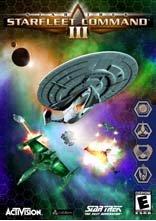
Red Alert! Star Trek games, like seemingly all games that are built around some sort of licensed franchise, are notorious for their lack of quality. Perhaps because of this, my expectations for this game weren't all that high. However, in Starfleet Command 3 (SFC 3), I was pleasantly surprised to find a gameplay experience that was genuinely deep and entertaining, if not entirely true to the Star Trek universe. I have not played the first two games in the Starfleet Command series, but from what I understand this is the first game to be based in The Next Generation time frame. The opening cinema puts the events of this game after the end of the Voyager TV series, but before the events of the movie Star Trek: Nemesis. As such, the plot of the game revolves around the construction of a joint Federation-Klingnon star base that can use its advanced sensors to detect cloaked Romulan ships. The Romulans, of course, aren't going to stand for this. The game allows you to experience the story from each side, starting with the Klingnons, then the Romulans, and finally the Federation. There is also a fourth campaign where a player can play as the Borg. Missions are scattered about an over world that consists of hexagons. Some missions are mandatory, while others are optional and can be completed on the way to a mandatory mission. Completing missions successfully earns the player "prestige points" which can be used as currency at friendly bases to buy new ships or upgrade your existing one. During the course of these campaigns, the player can upgrade and personalize his or her vessel with various weapons, computers, and engines. Each side has a wide range of basic vessels to choose from, including small frigates, light and heavy cruisers, and finally large battle cruisers and dreadnoughts. Another way that prestige can be spent is to recruit officers to staff your ship. Officers with high experience levels give your ship access to advanced capabilities, such as the aforementioned high-energy turn. The meat of SFC 3 is ship to ship combat. The player has control over weapons and shielding, and must maneuver their vessel so that the target is within their weapons' limited arcs of fire. Meanwhile, the player can drop mines or deploy shuttle craft in an attempt to distract or damage the enemy. There are also "high-energy turns" that can be used to turn your ship on a dime and reverse a bad tactical situation, but these turns run the risk of stalling your ship and leaving you defenseless for a few moments. A final option in combat involves beaming Marines over to a target to try and destroy a vital system or capture the vessel outright. Overall, the combat in this game is done well, although it is fairly slow-paced. Even an obvious mis-match, such as a very large ship against a very small ship, may take several minutes to complete. Graphically, this game is very pretty. All of the ships are very nicely detailed, and they even take visible damage as a battle progresses. There was very little slowdown on my computer, even with the detail levels set fairly high. The audio is also well done, with voice-overs from none other than Patrick Stewart featured prominently. The other voice parts and the music are solid and fit into the Trek universe very well, but I didn't find them particularly memorable. While I am very impressed with the general Star Trek atmosphere in this game, there are a few minor quibbles. For one, most of the non-Federation ships were created by the game designers and are therefore non-canon. This was necessary because only the Federation has a sufficient number of ships featured on screen to have an appropriate ship for every size and mission category. Also, SFC 3 makes a lot of use of Marines, for which little or no evidence exists in the various Star Trek series or movies. Trek trivia issues aside, a number of bugs make this game somewhat aggravating at times. For example, I was unable to complete the Federation campaign because the mission required me to beam and away team down to a planet that wasn't present in the map. There is a multiplayer mode to this game where the player can participate in either skirmishes against AI and human opponents or compete in a massively multiplayer online campaign. However, due to the Academy's firewall, I was unable to utilize these features. Overall, SFC 3 is an engrossing title that any self-respecting Star Trek fan can enjoy. That is not to say that this game is not without its flaws, however. A number of concessions had to be made in the name of game balancing that violate what Star Trek ships do in the movies and on TV. Also, there are a number of bugs that can bring the player's progress to a sudden halt if they aren't careful. Finally, the game is very sensitive to firewalls, so those who pick this game up for its multiplayer component beware. In the end, I can really only recommend this game to those Star Trek fans out there who have a burning desire to jump into a Galaxy class starship and beat the snot out of a Romulan Warbird. That is plenty good enough for me, but it is probably not enough to convince non-Trekkers to look past this game's flaws. By Andy Rucker |
|||||||||||||||||