

 |
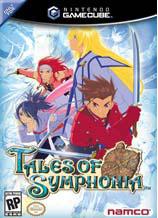
My path to completing Tales of Symphonia was a tortured one, thanks to a busy school schedule and other games that distracted me from playing it for long periods of time. As a result, I had the game fully 6 months before I finished it. However, it is a testament to the game's quality that even after several weeks away I was still eager to sit down and play more of it. Without a doubt, Tales of Symphonia is the most finely crafted and refined RPG I've ever played. That being said, in the end this game left me a bit cold. For whatever reason, I never really formed a bond with any of the characters in this game, certainly not to the extent I have with other games like Skies of Arcadia. Perhaps this is because Tales of Symphonia features a main cast of 7-8 characters, any 4 of which the player can have in their party at any one time. In other games, when there are just 3-4 characters, I find it easier to make a some sort of emotional connection to their experiences in the story. Now, the story of the game has a pretty wide scope, so there is enough going on for each character to have their own little piece of it. The main plot is the familiar "Young, idealistic hero saves world with help of friends" shtick, but the number of twists and side shows that are included keep things interesting. Battling through this story is more akin to the hack and slash style gameplay than the menu-based turn system used by many other RPGs. The player normally controls one of four characters battling on screen, performing basic physical attacks, combos, and magical spells using button combos on the controller. The system is full of options, for example the player can set his or her character to automatically block. Also, up to three other players can participate in a battle by controlling the other characters in the party by using additional controllers. Symphonia thus plays very differently than Final Fantasy games or other similar turn based RPGs. This has been a major turn-off for some gamers, but I didn't find it offensive in the least. The battle system is easy to get into, but also surprisingly deep. Many of the advanced multi-character combos called "Unison Attacks" can only be discovered by accident and require a fine sense of timing to pull off. As good as the battle system by itself is, it is nicely complemented by a remarkably user-friendly menu system. For example, equipping new items is a breeze thanks to an option that automatically selects the most powerful weapon or item for each slot in the character's inventory. However, if the player prefers to keep a closer watch on their party's equipment, they have the ability to manually select items for those slots. This example, along with the options in the battle system I cited above, showcase the amount of care that apparently went into crafting this game. The end result is a rich gaming experience that can be easily tailored by a player to suit their tastes and skill level. Not to be overlooked are the sounds and graphics of the game. Tales of Symphonia uses 3-D backgrounds with polygonal characters. Thanks to the power of the GameCube and techniques such as cel-shading the characters and environments look like something out of a story book. Many events in the game are portrayed using cut scenes made with the game's engine, but there are a few anime FMV sequences that dramatize key moments later in the game. Honestly, I wish that there were more of these sequences since they were very well done, but oh well. Although the game looks beautiful, I almost found that the graphical style clashed with the story quite a bit. Far from being a lighthearted story book, Tales of Symphonia is a story full of prejudice, murder, and tragedy. One wouldn't guess that just by looking at it. The sound is also very nice, with a substantial portion of the game's dialog being voiced. Fortunately the voice talent did a good job establishing a separate personality for each character, which is important with such a large main cast. I found the game's music to be barely adequate, however. While the music was fitting to each scene and was of good technical quality, none of the songs grabbed me as being overly memorable. On top of that, I found that there was a general lack of variety overall. There was one song, for example, that played at every enemy base you entered, and over the course of a 50-60 hour game that wears on you after a while. I should mention that Tales of Symphonia has an interesting hook to encourage replaying the game. Characters earn something called Grade based on how well they do in battles. At the end of a game, a player can use the Grade they have accumulated to "purchase" different perks for the next play-through. For example, a player can start out with all the abilities they learned in their previous game, or double the experience they learn from every battle. This, combined with some story twists and alternate events that require multiple playings to see, is a remarkable incentive to stick with the game even after beating it once. I am honestly looking at starting another game in the not too distant future. In the end, I think that Tales of Symphonia is a highly polished game that is a welcome addition to the GameCube's thin RPG library. However, this game fell short of being an epic experience for me in the same way that other RPGs like Skies of Arcadia were. This could be chalked up to the fact that I didn't play the game straight through, but I think that the sheer number of characters and the music especially prevent this game from being as memorable as it could be. Nevertheless, Tales of Symphonia is not only a deep, highly polished, and complete RPG experience, but it is also a very accessible and customizable game. Thus, I heartily recommend it to all GameCube owners out there. Oh, and in case you were wondering, I have no clue as to what a "Symphonia" is, and the game never really bothers to tell you. Go figure. Andy Rucker
|
|||||||||||||||||