


 |
Review: Bandai's Enterprise-E Model Kit

Before I begin, I should note that this model has been out for some time now, so you will be able to find a lot of information out there regarding the exact technical aspects of it. Consequently, instead of focusing on these aspects I am going to turn to my impressions of the model's design, appearance, and overall value. Also, you should be on the lookout for some fan-boyish Trek ranting ;).
Disclaimers aside, I want to say right up front that this kit is a beautiful model that any Star Trek fan would be proud to display on their desk. This model is made by Bandai, who apparently channeled decades of cumulative experience gained from making Gundam models into making this jewel. At first blush, the Enterprise-E did not strike me as much of a kit. Conditioned by an adolescence spent (poorly) building AMT/Ertl Star Trek kits conditioned me to expect a large number of ill-fitting parts cast in white or grey styrene. The Enterprise-E, however, is of snap construction with no gluing required. On top of that, the model comes completely pre-painted and decaled, down to the tiny Starfleet logos and "Aztec" pattern. The model is also lit, which means I had to, horror of horrors, deal with wiring and light bulbs as I built it.
Even with the lighting effects, construction wasn't that difficult. There are six bulbs total, and they all come with leads attached that have been cut to the proper length and stripped. The wire connections inside can all be done by twisting the wires around a contact. I suppose the more anal of modelers out there will pull out the soldering iron "just to make sure," but I don't think it will be a problem. The parts themselves all fit together very well, provided that they are cleanly cut from the sprues and assembled in the proper order. The fit of the pieces is so tight that even the smallest glob of flash will result in improper seating of the parts. The snap together assembly initially gave me concerns that the model wouldn't be able to hold up under handling, but these fears turned out to be unfounded. The parts of the model, once properly assembled, have a death grip on each other. This has the side-effect of making it difficult to disassemble the model to insert a part forgotten earlier in the assembly (As I found out the hard way!).

Pretty Spiffy.
The finished model is really quite a sight. Adjectives fail me, but when I showed it to my Dad, he described it as "Sharp!" And really, that suits Bandai's Enterprise-E to a tee. All of the painting is sharp, all the markings are clearly legible, and the sculpt of the model captures the on-screen character of the ship very well. However, when the model's lights are activated in a darkened room, it takes on a whole new character. Even though only six bulbs are used, the light is defused very evenly throughout the model. Every lit Federation starship toy or model worth its salt will have glowing warp nacelles, impulse engines, and navigational deflector. The Enterprise-E goes an extra step and throws a gazillion tiny lit windows. These windows are what really sets this model off for me, and almost makes me believe I am looking at a studio model. Now, there are some downsides to the lighting system. For one, the model can only be lit when attached to its base, which prevents any free-flight fun with lit warp engines. Additionally, the model makes no effort to simulate the spotlight effect used by Federation starships to self-illuminate their name and registry. Also, the navigational deflector is lit much more brightly than is seen on screen, giving the impression that the Enterprise-E is off to fight a horde of ticked-off Romulans with nothing but a giant yellow flashlight.
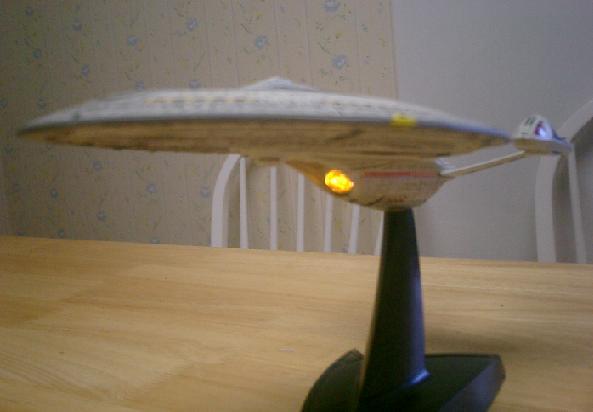
Red Alert! Warbird sighted off the port bow. Mr. Worf, activate the Giant Flashlight!
Detail wise, I compared my model with the CG model used in Star Trek Nemesis, and noticed several very slight detail differences. For one, the Aztec pattern on the model is much coarser than the movie ship's is. This is undoubtedly a concession to the smaller scale of the model, however, and doesn't affect the overall appearance of it. Other discrepancies included minor placement issues with the life boat hatches (the yellow pentagons with red outlines) on the ventral side of the secondary hull, and grey areas of the hull are overly dark. And, while I can't be sure, it seemed like I had difficulty matching the model with certain CG shots from the movie, specifically the shots taken from an aft perspective towards the end of the movie as the Scimitar is overtaking the Enterprise. However, given how well the model stacks up to most of the other shots, I am almost persuaded to think that the problem lies with an rendering error in the movie.
On the whole though, these issues with the lighting and detail are really nit-picky concerns that don't detract from the beauty of the model. As I said, the lighting is good enough to give an impression of a studio miniature, and the details are close enough to make the model a dead ringer to the on screen ship. I had to examine freeze-frames of the Star Trek Nemesis DVD just to find the few small issues that did! In fact, there is a lot more that is right about this model than is wrong with it. For example, in those freeze frames I also happened to notice that all the windows are exactly where they are supposed to be!
The first time I saw the Enterprise-E on screen in Star Trek First Contact, I just new I had to have a model of it. This kit produces a miniature that is easy to assemble, beautifully lit and decorated, and reasonably large at around 16" in length. The only real shortcoming of the kit is that it is pretty pricey. I bought mine in Akihabara, Japan for 6,000 yen (about $55), but it will cost significantly more through online retailers and I have yet to see this kit in American stores. Nevertheless, my recommendation is that it is worth the cost and hassle to find this superb kit.
By Andy Rucker

You know you want it.